I09N: Fremantle to Phuket
March 21, 2025
Overview
GO-SHIP I09N 2025 ran aboard the R/V Thomas G. Thompson from Henderson (Fremantle), Western Australia, to Phuket, Thailand, under Chief Scientist Viviane Menezes and Co-Chief Scientist Leah Chomiak, with a Bangladesh Navy Naval Observer (Lt Cdr Sazzad Hossen) embedded for the first time to enable sampling in Bangladesh’s EEZ at the line’s northern end.
Operations
Departure was delayed four days, from March 17 to March 21, when Australian customs held the DIC van in Singapore over trace acetone (a controlled substance in Australia); once cleared, the van crossed to Fremantle aboard the M/V Jogela and reached the ship just a day before sailing, trimming the planned station count from 122 to 106 before the cruise even began.
The first week at sea then delivered a cascade of equipment failures: both CTD test stations suffered winch-software freezes, unfiring bottles, and a tangled cable; the aft winch failed outright at Station 2, forcing a switch to the forward winch; a chronically noisy altimeter plagued repeated stations; Station 7’s CTD failed on the way up with inconsistent bottle closures; and Station 8 saw a total system failure (“nothing functioned”) compounded by a simultaneous failure of the ship’s Z-drive propulsion, holding the vessel in place for nearly three days while Tropical Cyclone Courtney intensified nearby — the delays, ironically, kept the ship out of the storm’s path.
The wire was ultimately found to be the culprit and re-terminated on the fourth attempt, after which operations stabilized; the reduced station plan bottomed out at 89 before recovering to 100 in Week 4 as fair weather, a functioning CTD, and a one-day cruise extension from the ship let the team claw back 12 stations, finishing with 98 completed (two skipped near the Bangladesh/Myanmar EEZ boundary to avoid a diplomatic complication, offset by nine entirely new stations sampled inside Bangladesh’s EEZ compared to prior I09N occupations in 1995, 2007, and 2016).
Scientific highlights
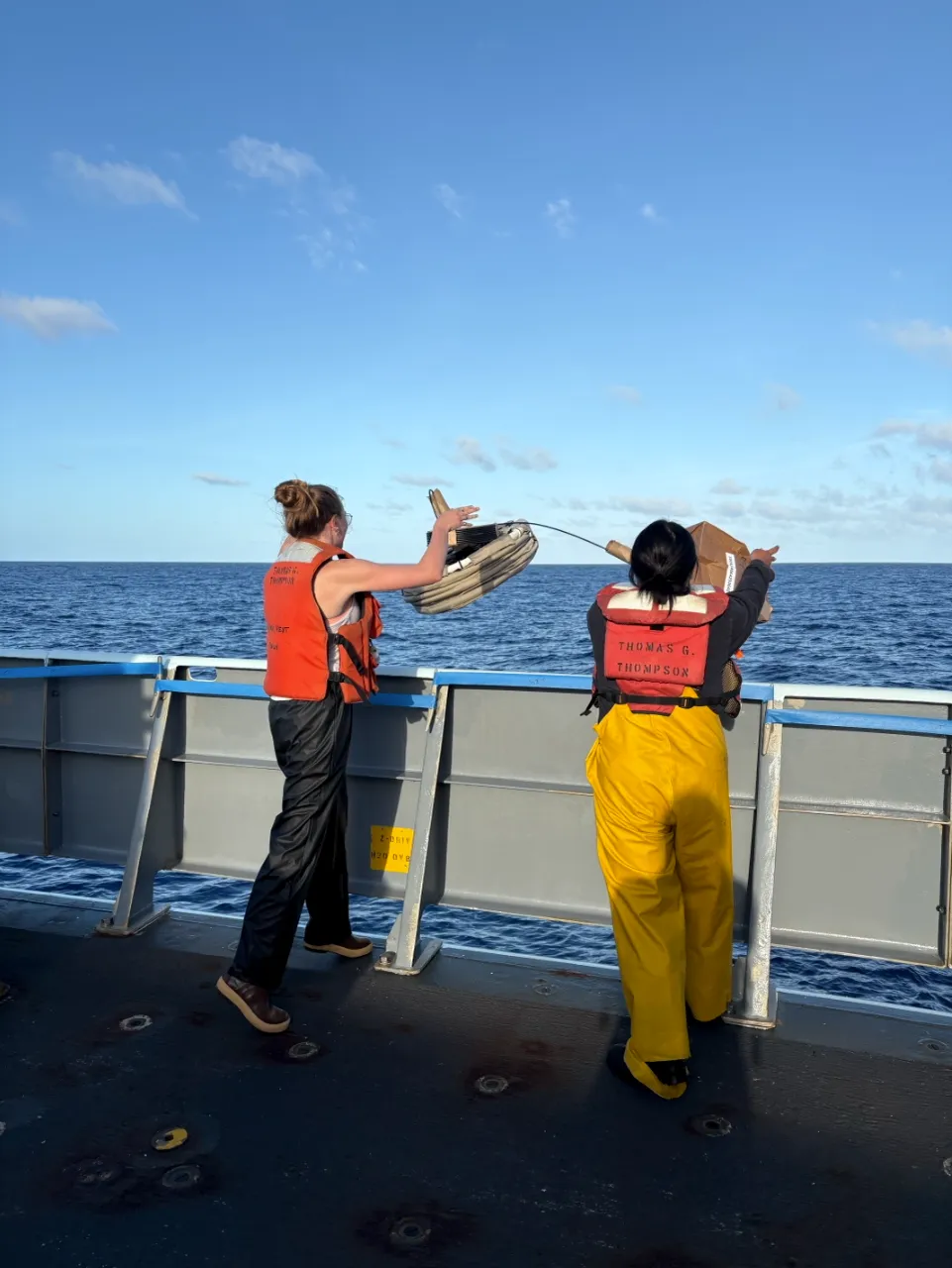
Along the way the cruise deployed Core and BGC Argo floats, SQUID floats, and Global Drifter Program surface drifters; crossed the Wyrtki Jets and the equator (marked with a seawater bucket-shower ceremony); and, in the Bay of Bengal, mapped the basin’s pronounced oxygen minimum zone (oxygen near zero between the 26 and 27.3 kg/m3 neutral density surfaces, roughly 150-900 m) alongside a textbook salinity section showing the Subtropical Underwater salinity maximum, Antarctic Intermediate Water’s fresh signature near 1000 m, and the fresher Indonesian Throughflow Water intermingling with it near 15°S.
Fun facts
Styrofoam cups were dutifully crushed and sent down on casts exceeding 6,000 m; a small fishing boat strayed within feet of the CTD wire mid-cast, prompting an emergency recovery with bottles fired on the fly; the science party and crew squared off in a competitive Easter-basket-decorating contest; and the Chief Scientist briefly filled in as CTD watchstander during the equator-crossing ceremony before being relieved for a fresher set of eyes.