I08S: Fremantle to the Antarctic Shelf and Back
February 21, 2024
Overview
GO-SHIP I08S 2024 ran February 21 to April 1, 2024, as a round trip aboard the R/V Thomas G. Thompson out of Fremantle, Australia, under co-chief scientists Sebastien Bigorre and Katelyn Schockman, reaching as far south as 67.1°S, 76.6°E in Prydz Bay on Antarctica’s continental shelf (Station 1, March 4) before working back north to a crossover with the I05 line at 28.3°S, 95°E (Station 66, March 28).
The cruise completed all 66 planned stations (66 core CTD casts, 9 dedicated biological casts, and 12 combined casts using 3 of 36 Niskins for biology), deployed 15 Argo floats (7 BGC, 7 core, 1 deep) and 10 surface drifters, and logged an average cast depth of 3,213 m with the rosette traveling a cumulative 424,126 m (263.6 statute miles).
Operations
Mobilization in Fremantle’s brutal ~45°C heat was complicated by a detained PMEL lab van in Singapore, requiring emergency backup DIC shipments and roughly 2,200 spare sample bottles airlifted in from PMEL, AOML, and Scripps as a contingency; nearly all arrived in time except one chemical sourced locally.
The Southern Ocean crossing proved relentlessly stormy: seven storms directly impacted operations over the cruise, including a punishing Roaring Forties system with 30 ft seas and 40-50 knot winds that stalled the ship’s southbound transit to under 5 knots, and a further run of three storms between March 8 and 14 near the Kerguelen Plateau that halted CTD work for four of seven days, produced a 4,500 lb snap load on the rosette during one recovery, and forced station spacing to be stretched from the standard 30 nm up to 100 nm to outrun weather; in total, weather cost the cruise an estimated 6.8-8.4 days.
Equipment hiccups included a misconfigured CTD altimeter (fixed after realizing its bottom-detection threshold was set to 100 m instead of 10 m), a missing Niskin bottle recovered clean off its lanyard at Station 8, two separate SeaSave software freezes (Stations 26 and 49) worked around without aborting the casts, a failed secondary conductivity sensor swapped before Station 54, and a winch wire that twice made contact with the ship’s hull during rough-weather deployments.
Scientific highlights
Preliminary shipboard science highlights included potential-density sections tracing Antarctic Bottom Water spreading north from its formation region and a clear signature of the Polar Front near 50°S in the temperature data.
Fun facts
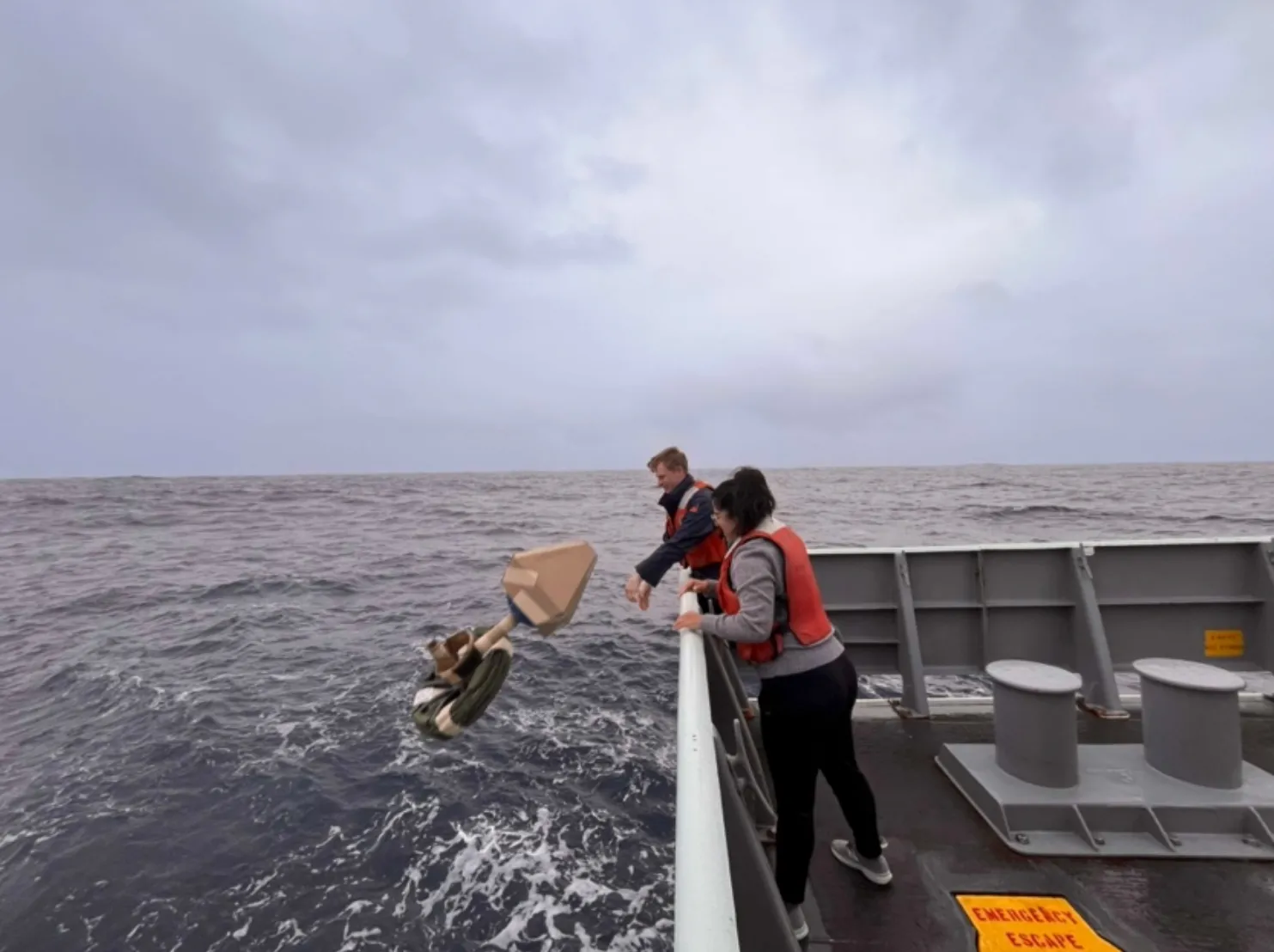
The crew crossed the Southern Polar Circle with an impromptu night of comedy, puppetry, singing, and dancing; two BGC floats were hand-decorated before deployment; a curious penguin circled the ship for an extended visit, drawing most of the off-watch science party to the back deck; the Southern Lights (aurora australis) appeared intermittently during clearer stretches of weather; and, once conditions finally calmed in the tropics, the team sampled a CTD cast in the open staging bay (rather than the enclosed one) for the first time all cruise.