I05: Fremantle to Cape Town
July 22, 2023
Overview
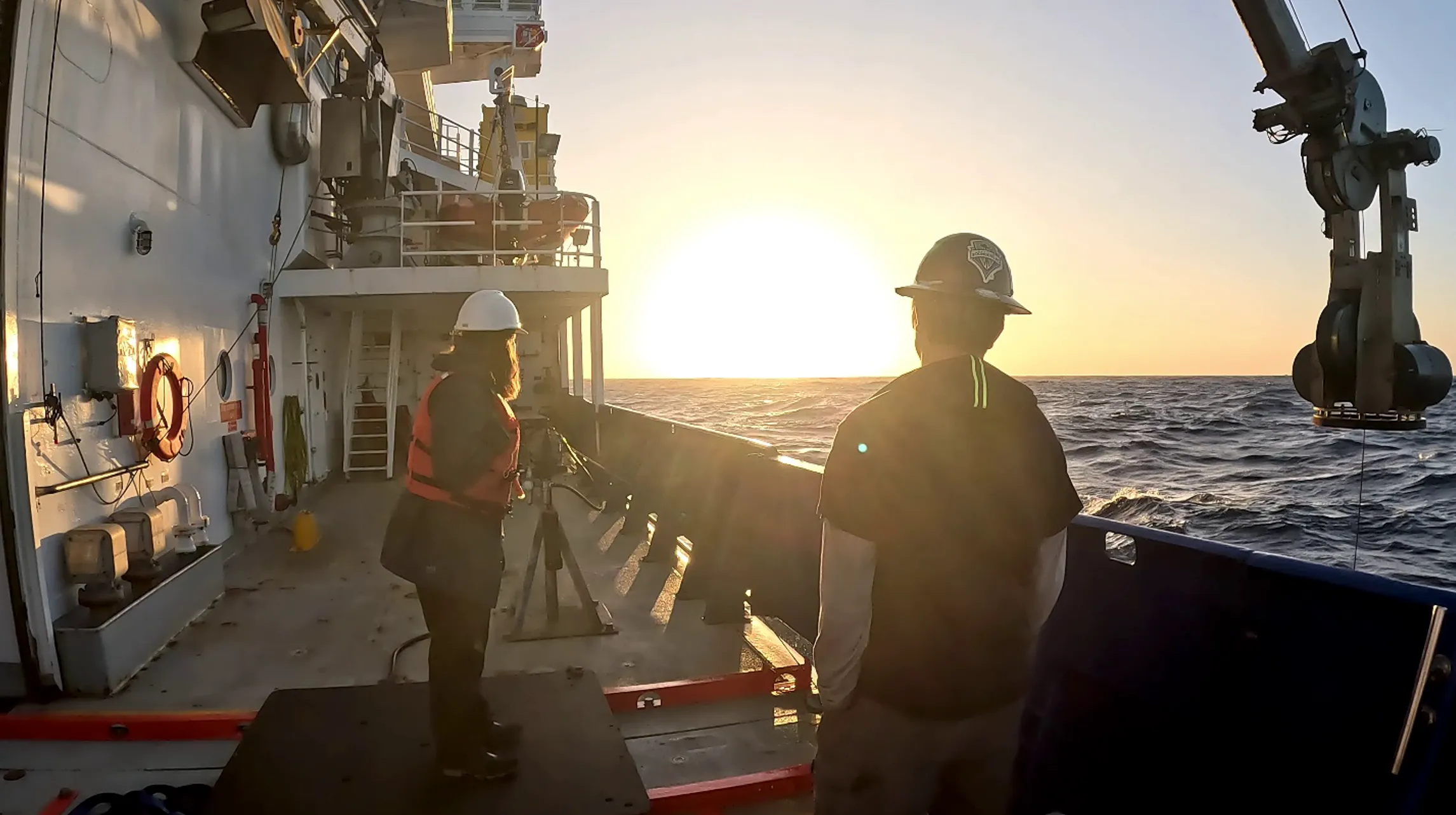
GO-SHIP I05_2023 ran July 22 to September 14, 2023 (55 days at sea) aboard the R/V Roger Revelle from Fremantle, Australia, to Cape Town, South Africa, under Chief Scientist Brendan Carter and Co-Chief Scientist Kay McMonigal.
The cruise completed all 196 planned stations (195 full bottle casts plus 50 dedicated biological casts) and deployed 15 floats (including SQUID and biogeochemical Argo floats individually named and decorated by the science party, among them The Excelerator, Gator, Hooter, Sweet Caroline, Nautifish, Saturna Island, Leibniz, and Wildcats) and 22 drifters, tracing a deliberately non-linear track across the Perth, South Australian, Crozet, and Mozambique Basins to capture the deepest and densest Antarctic Bottom Water pathways through the Indian Ocean’s ridge-and-basin bathymetry.
Operations
Mobilization required a last-minute berth change to accommodate shore-crane needs and two late crew substitutions (Aurélie Moulin and Eva Capilla Garcia stepping in), and the cruise weathered a run of early setbacks: intermittent CTD modulo errors beginning at Station 7 that escalated to a pump-cycling failure at Station 12 requiring roughly 12 hours of at-sea troubleshooting; an unusually strong (>1.2 m/s), likely eddy-driven Leeuwin Current jet at Stations 12-13 that pushed the CTD package dangerously under the ship, forcing a partial cast and relocation of Station 13 to a new midpoint Station 14; and a rogue wave that flooded and damaged the transient-tracer (CFC) van, requiring the team’s relocation to the hydro lab and a full rebuild of their measurement system (later joined, on the return transit near Cape Town, by a second wave that damaged the DIC container and partially dislodged the spare rosette).
Multi-day bouts of Southern Ocean-adjacent winter storms (including a 21-hour, ~6.8 m wave event) periodically halted station work, prompting time-saving measures such as depth-truncated bottle sampling on ridge crossings and folding biological Niskins into the main rosette cast when efficiency allowed, while a final push through the notoriously fickle Agulhas Current closed out the science program on schedule.
Scientific highlights
Scientific highlights included at-sea preliminary analyses of deep (>2000 dbar) Indian Ocean warming since the 2009 occupation (mean rates of roughly 0.001-0.005°C/year below 3600 dbar, with the densest waters warming most) and of anthropogenic carbon accumulation using the CAREER approach, hinting at a possible slowdown in ocean carbon uptake relative to 1995-2009 that was not yet statistically distinguishable from noise; the cruise also served as a live testbed for machine-learning-assisted data QC methods under development in the Chief Scientist’s group.
Fun facts
The Excelerator float deployment pushed the “Adopt-a-Float” outreach program past 500 adopted floats and briefly crashed the website; the Leibniz float was decorated with a hand-derivation of Ekman transport; shipboard life included a ping-pong tournament, an informal book club, a betting pool on future mixed-layer depths, an off-shift Dungeons & Dragons campaign, and the Chief Scientist learning to read Tarot cards; the ship passed within about 2 degrees of the exact antipode of its home berth in San Diego; and the final dockside photo in Cape Town reportedly hides two sleeping harbor seals near Table Mountain.