A16S: Punta Arenas to Cabo Verde
March 9, 2026
Overview
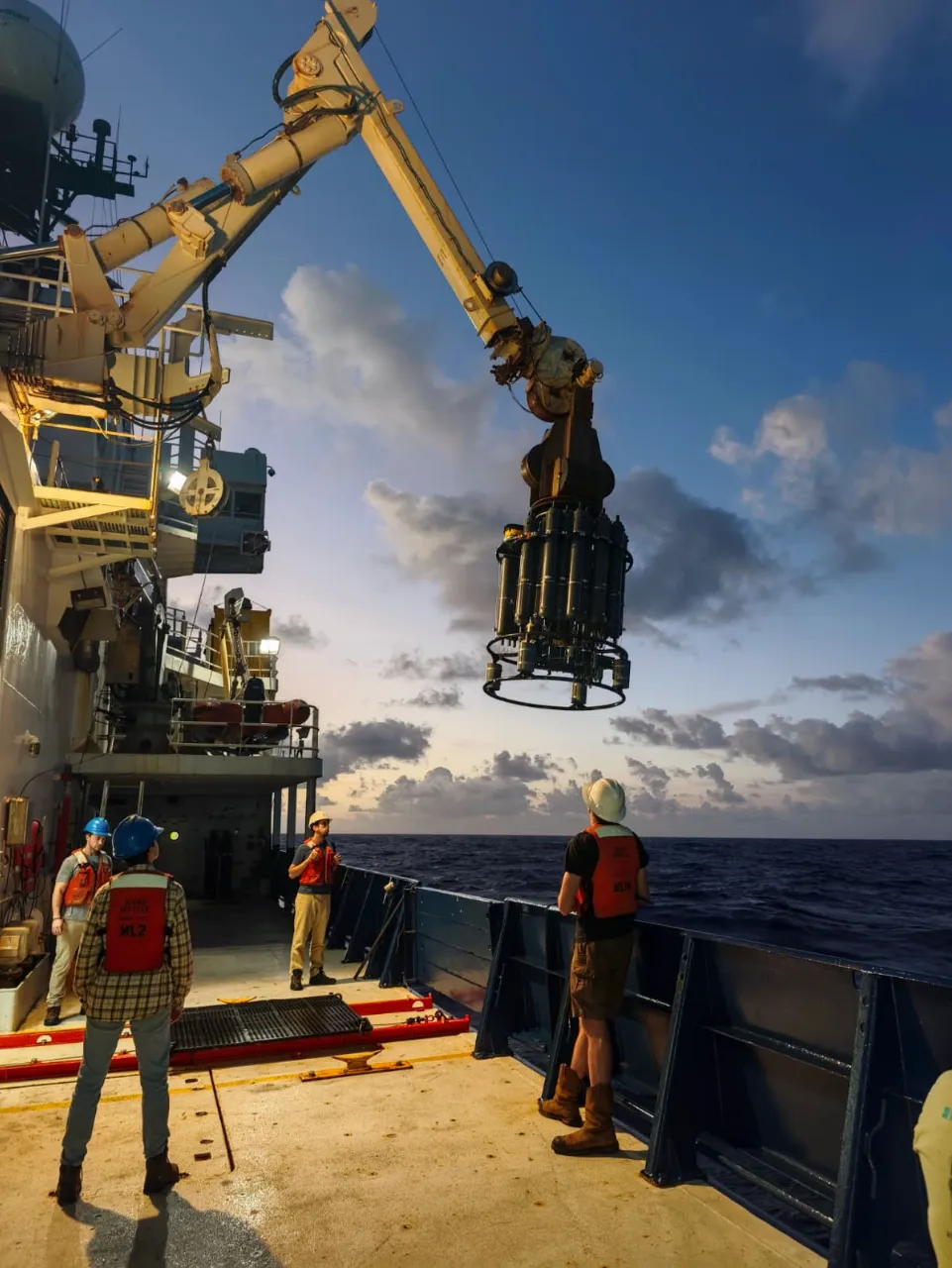
GO-SHIP A16S ran aboard the R/V Roger Revelle from Punta Arenas, Chile, to Mindelo, Cabo Verde, in two attempts: an initial departure on March 9, 2026, cut short by an onboard fire on March 13 that forced a week-long return to port for repairs, and a restart on March 25 that retraced the route through the Strait of Magellan to reach Mindelo on May 1, for a science party that spent nearly two months at sea across both legs.
Facing a reduced timeline, the team initially adopted a “survival plan” cutting all stations south of South Georgia and 10 stations in the northern section, but through favorable weather and an efficient pace not only reclaimed every cut station but added a bonus station, finishing with 96 CTD stations total (including 4 overlap stations with the 2023 A16N occupation to anchor the full meridional section) alongside deployment of Argo floats (core, deep, and BGC) and surface drifters.
Operations
Early legs were dominated by navigating bergy waters near South Georgia generated by the disintegrating megaberg A23a (the largest iceberg ever recorded, tracked by scientists since the 1980s), which forced 6-knot transits in low visibility and a westward diversion off the planned track to about 46°S; the ship later weathered an extratropical cyclone (15-18 ft seas, 35-40 knot winds) that had also struck Uruguay, without losing a single station, and later sprinted at 14 knots to outrun a second storm system.
Scientific highlights
Scientific highlights included the densest fCO2 coverage yet achieved on a GO-SHIP line, PMEL-led CFC-11/12, SF6, and N2O transient-tracer measurements documenting NADW tracer penetration to the equator and enabling water-mass age estimates (combined with the 2023 A16N data), an apparent oxygen utilization comparison against the 2014 occupation suggesting long-term deoxygenation, and a UC Irvine-led Bio-GO-SHIP effort (165 underway and 26 CTD stations, nearly 2,000 preserved samples, PACE satellite validation) that sampled from bergy Southern Ocean diatom communities near A23a to equatorial Sargassum patches, a full-circle biological transect mirroring A16N’s own Sargassum-to-spring-bloom story.
Fun facts
The crew crossed the equator to a ship’s-horn salute; CTD-watch stander Haruto Fujishima prepared sashimi from a squid caught off the fantail; the science party spotted an endangered oceanic whitetip shark; a shipboard birthday was celebrated with hula hooping, tetherball, and a makeshift deck pool; Argentinian observer Dr. Carla Berghoff led a collaborative cruise-long artwork piece tracing the ship’s track; and the final station’s last water sample was met with a spontaneous round of cheers and applause from the whole science party.